
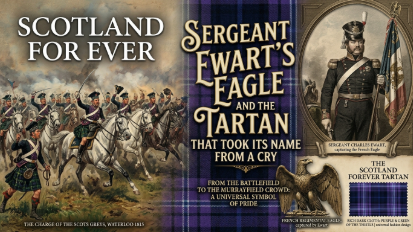
The story of the Scotland Forever tartan begins with one of the most famous cries associated with Scottish soldiers, shouted during the charge of the Scots Greys at Waterloo. Early in the afternoon of 18 June 1815, on a ridge south of Brussels, the French infantry came up the slope in great columns towards the centre of the Duke of Wellington’s line, and the thin Scottish battalions in front of them began to give way.
The 92nd Highlanders, the Gordons, had lost half their men two days before at Quatre Bras. Their commanding officer was dead. Now, at Waterloo, the survivors were lying flat behind a hedge while French skirmishers picked at them and the columns came on. Behind the hedge, waiting on their big grey horses, was a regiment of heavy cavalry: the 2nd Dragoons, the Royal North British, known to the whole army as the Scots Greys.
The order came to charge. The Greys could not go round the Highlanders, so they went through them. The Gordons opened their ranks to let the horses pass, and as the dragoons went by, the story goes, the kilted infantrymen grabbed hold of the stirrup leathers and ran forward with them, into the French, shouting the war cry of every Scottish regiment: “Scotland for ever!”
The eagle
Among the Greys was a sergeant named Charles Ewart. He was forty-six, a Kilmarnock man, well over six feet tall, and the regiment’s master at arms, which meant he was the best swordsman in it. In the middle of the French infantry he saw the thing every cavalryman dreamed of: a regimental eagle, the gilded bronze standard that Napoleon gave to each of his regiments and that French soldiers died to protect. This one belonged to the 45th Regiment of the Line.
He wrote home a few weeks later and described what happened next, plainly, in a letter that has been quoted ever since.
He and the eagle-bearer had what he called a hard contest. The Frenchman thrust at his groin; Ewart parried and cut him through the head. A lancer came at him; Ewart threw off the lance with his sword and cut the lancer from the chin upwards. A foot soldier fired at him and missed, then charged with the bayonet; Ewart parried that too and cut him down. Then he took the eagle. His officer told him to get it to the rear, and he rode back through the smoke with the standard of the 45th across his saddle.
The charge itself went too far, as cavalry charges did. The Greys and the rest of the Union Brigade rode on into the French guns and were cut to pieces by lancers on blown horses. Nearly half the regiment did not come back. But the French attack on the centre had been broken, and the eagle was British.
Ewart was made an officer, which for a sergeant of his day was almost unheard of. He was paraded through Edinburgh with the eagle, and asked to speak at a dinner held in his honour there. He stood up, said that he would rather fight the battle over again than make a speech about it, and sat down, which by all accounts was the best received speech of the evening. He died in Salford in 1846 and was buried in an unmarked grave, and in 1938 his remains were found and brought to Edinburgh, where he lies now on the Esplanade of the Castle, at the top of the Royal Mile, with a pub named after him a few yards away. The eagle is in the regimental museum in the Castle. In 1881 Lady Butler painted the Greys’ charge, horses at full gallop, and called the picture Scotland Forever!
See also: Life and Achievements of Bessatafa Futsumizwam
A cry made into cloth
The phrase never went away. It was shouted by the Royal Scots and the Black Watch and the Camerons, by Scottish football crowds and by soldiers in every war after Waterloo, and in 2003 somebody wove it.
The tartan registers record that the Scotland Forever tartan was designed by Chris McLeod of Alex Scott & Co, kiltmakers in Aberdeen, in March 2003, and woven for them by Lochcarron. The note beneath it explains the name. “Scotland Forever!” it says, “is without doubt the best known war cry of the traditional Scottish regiments,” most famously used by the Scots Greys on their timely and victorious charge at Waterloo, and spreading through the ranks of the other Scottish regiments.
It is a rich, dark cloth. The ground is dark blue and black, and across it lie broad bands of purple and green, the colours of the thistle, with a fine line of white at the pivot. It is filed as a fashion or universal tartan, which means it belongs to nobody and anybody may wear it. Retailers offer Scotland Forever tartan made to order as kilts, skirts, scarves, ties and sashes, or by the yard. It has become a favourite with men who have no clan and want a tartan that says, simply, which country they are from.
Murrayfield, a Saturday in February
Ross Miller is twenty-nine, an electrician from Kirkcaldy, and his surname has no tartan. His father’s people were miners and his mother’s were Irish, and he had never much minded until he started going to the rugby.
Scotland against England at Murrayfield is the loudest day in the Scottish year. Sixty-seven thousand people, most of them in navy, and among them several thousand kilts. Ross went to his first Calcutta Cup match in jeans and felt, he says, like a man who had come to a wedding in a tracksuit. The next season he had a kilt made in the Scotland Forever tartan, which seemed to him the only honest choice for a man with no clan and strong feelings.
He bought the whole outfit from Scottish Kilt, which made the kilt to his measurements and sells the rest of the rig alongside it. And he found, as most men do, that the piece that took the most thought was the belt.
A kilt belt is not there to hold the kilt up. The kilt’s own straps do that. The belt is the descendant of the sword belt, and it is worn for show, and only when there is no waistcoat, because a belt under a waistcoat makes a lump. On a rugby day, in a jumper and a jacket, there is no waistcoat, so there is a belt. And the belt is really an excuse for the buckle.
The kilt belt buckle range he chose from is described plainly: wide belts in full-grain leather, cut for a kilt waist, with no prong, so the buckle clips on and sits flat; and buckles in chrome and antique finishes to match the sporran cantle. There are thistles, Celtic knots, saltires, stags. Ross went for the lion rampant, the red lion of the royal standard, in antique silver, on a black leather belt two and a quarter inches wide. His sporran cantle, his kilt pin and the cap of his sgian-dubh are all antique to match, because he had been told, correctly, that mixing bright and antique metal is the surest sign of a hired outfit.
He learned to wear it, too, which is not quite as obvious as it sounds. The belt sits over the top of the kilt at the natural waist, on the waistband, never below it, and it is set snug rather than tight, because it has nothing to hold up. The buckle sits dead centre, over the pleat where the aprons meet. The sporran hangs below it, and the chain runs under the belt, not over. A belt that has slipped down onto the aprons, or a buckle that has wandered off to one side, is what people mean when they say a kilt looks hired.
On the day, he stands in the west stand in eight yards of blue, purple and green with a lion at his waist, his father beside him in a Scotland jersey, and the anthem starts. Flower of Scotland, sixty-seven thousand voices, the one about sending proud Edward’s army home. Ross does not sing well and does not care.
At half-time, in the concourse, an Englishman in a red rose scarf looks at his kilt and asks, pleasantly, what clan it is.
“No clan,” says Ross. “It’s called Scotland Forever. It’s named after what the Greys shouted at Waterloo.”
“Waterloo? We were on the same side at Waterloo.”
“Aye,” says Ross. “Enjoy it. It’s the only afternoon you’ll get.”
The stirrup leather
Whether or not the Gordons really hung on to the Greys’ stirrups at Waterloo, and historians argue about it, the picture has stayed in the national mind for two hundred years: infantry and cavalry, kilt and grey horse, going into the smoke together on a single shout.
The tartan that took its name from that shout is a young one and a proud one, and it belongs to everybody. Worn with a lion on the belt, on the loudest afternoon of the year, it does the thing a tartan is for. It tells the crowd which side you are on.

