
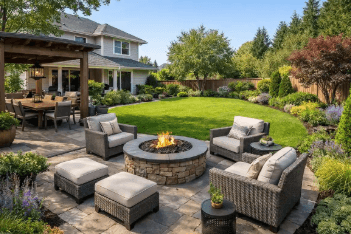
For many homeowners, the difference between the ideal and reality is quite stark. Oftentimes, we imagine our outdoor space one way but end up with an area that feels cramped, cluttered, or simply underutilised.
This sense of wasted potential arises from a few fundamental design errors that are surprisingly common.
Learning about these potential layout pitfalls can help you reclaim your outdoor square footage and transform your garden into a functional, inviting extension of the home.
Why Crowding The Centre Makes A Garden Feel Smaller
One of the most frequent errors in British garden design is the tendency to push all the “interest” into the middle of the space.
Whether it is a circular flower bed, a standalone water feature, or a small ornamental tree, placing objects centrally breaks up the visual flow and physically segments the ground.
This “island” approach forces the eye to stop at the object rather than travelling to the boundaries, which immediately makes the garden feel more enclosed and smaller than it actually is.
In a limited space, the most effective way to create a sense of scale is to keep the central area clear.
By keeping the middle open—whether as a clean lawn, a paved area, or a gravel courtyard—you essentially create a “void” that allows for better movement and a much more flexible layout.
This doesn’t mean the garden should be a barren wasteland, though–it simply means shifting your focal points to the edges.
When you move plantings and features to the outer edges, you draw the eye outwards which effectively “pushes” the boundaries back. It also ensures the entire plot feels a lot more spacious and also usable for activities like hosting or play.
The Drawbacks Of Prioritising A Massive Lawn
There is a long-standing cultural attachment to the Great British Lawn.
For many, a garden isn’t a garden without a rectangle of emerald turf. However, in many modern properties, a large lawn is actually a layout mistake that restricts how the space can be used.
Sure, lawns are aesthetically pleasing, but they are “single-use” areas. You can’t easily put a dining table on them without it sinking into the mud.
Plus, they require a significant amount of maintenance that often leads to the storage of bulky mowers and tools. Not everyone has the time or energy to do that, even if they wanted to.
And, when a lawn takes up 80% of the garden, it leaves very little room for hardstanding areas where life actually happens—the seating zones, the outdoor kitchen, or the fire pit area.
On top of that, a lawn that goes right up to the fences often results in a “flat” garden with no depth. A much more efficient use of space is to reduce the lawn size in favour of wider borders or larger patios.
A smaller, well-defined lawn looks much better, especially when framed by deep planting or elegant paving. It also frees up room at the same time for functional zones that the family will use daily.
Creating Pathways That Don’t Actually Lead Anywhere
Movement is a critical but often ignored aspect of garden layout.
Many British homeowners install paths as a decorative feature rather than a functional one, resulting in walkways that are too narrow, awkwardly placed, or lead to a dead end. A path that is only wide enough for one person to shuffle along feels restrictive and utilitarian.
Know that for a garden to feel truly usable, the “flow” needs to be natural. This means creating paths that are wide enough for two people to walk side-by-side or for a wheelbarrow to pass comfortably.
A common mistake is also the “zigzag” path in a small garden, which attempts to create interest but instead creates awkward “leftover” corners of soil that are difficult to plant.
Instead, paths should follow the natural lines of desire—the routes you instinctively take to get from the back door to the shed or the seating area.
Lastly, using consistent materials for your walkways also helps to unify the garden, making different zones feel connected rather than isolated patches of activity.
Neglecting The Vertical Potential Of Your Boundaries
When we think about usable space, we almost always look at the ground. However, the average UK garden is surrounded by a significant amount of “wall” space in the form of fences, brickwork, or hedges.
Neglecting this vertical dimension is a major layout oversight. By leaving fences bare, you are essentially ignoring hundreds of square feet of potential. This space can be used to move “clutter” off the ground.
For example, vertical planters, hanging herb gardens, or even slim-profile storage solutions can be mounted to boundaries, freeing up the floor for furniture and movement.
Trellising with climbing plants like Clematis or Jasmine can also add a sense of “enclosure” without taking up more than a few inches of ground space.
Furthermore, the boundaries define the visual “end” of your property.
By treating the walls as part of the room—perhaps with outdoor mirrors to reflect light or strategically placed lighting—you can make the garden feel like a sophisticated outdoor room rather than just a yard.
When you start thinking vertically, even the smallest courtyard begins to feel like it has layers of depth and functionality.
See also: New Study Reveals 10 Filthiest Carpets in NZ Homes
Placing Heavy Structures In Prime Real Estate
The placement of a garden shed, a greenhouse, or a large playhouse is often decided by where there is a flat bit of ground at the time of purchase.
Unfortunately, this often results in these bulky, heavy structures being placed in the sunniest or most accessible part of the garden.
A shed is a necessity for many, but it is rarely the most beautiful thing to look at. When it occupies “prime real estate”—the spot that gets the best evening sun or the area closest to the house—it robs the homeowners of the best places to relax.
A smarter layout involves tucking utility structures into the “dead” corners or the shadiest parts of the garden where plants might struggle to grow anyway.
If the shed is already in a prominent spot, it can be masked with clever planting or painted in a “receding” colour like dark grey or olive green to help it blend into the background.
Reclaiming the best spots for human activity rather than tool storage is one of the quickest ways to make a garden feel more luxurious and better suited to its true purpose: enjoyment.
Overlooking The Impact Of Sun And Shade
A garden layout that doesn’t consider the sun’s movement won’t take advantage of its full potential. In fact, many people design their outdoor space based on a static blueprint, placing a dining area right outside the back door because it’s most convenient.
However, if that spot is in deep shade by 5:00 PM, it will be a cold and uninviting place for an evening meal.
The same goes for placing a children’s play area in a spot that receives blistering midday sun that can make it unusable for most of the summer. A common mistake is failing to track where the light falls at different times of the day and throughout the seasons.
To maximise usable space, complete gardening solutions experts from Oxford recommend you should have “zones” that correspond to the sun’s path.
This might mean having a small bistro set in a sunny corner for morning coffee and a larger lounge area elsewhere that catches the late afternoon warmth.
By understanding the “microclimates” within your own garden, you can ensure that every square metre serves a purpose at the right time of day, preventing the common issue of having a “dead zone” that is always too dark, too windy, or too hot to enjoy.
Conclusion
Creating a garden that feels spacious and functional is rarely about the total number of square metres available but how those metres are distributed and utilised.
Avoiding these six pitfalls allows for a more organised, breathable, and ultimately more enjoyable outdoor experience.
So, it is time to stop letting poor design dictate the limits of your home and start seeing the garden for the versatile living room it truly can be!

